
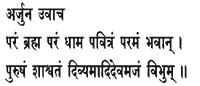
Arjuna said: Thou art the supreme Brahman, the supreme Abode, the supreme Purity, the one permanent, the divine Purusha, the original Godhead, the Unborn, the all-pervading Lord.
The Gunas, Mind and Works
Sri Aurobindo
THE GITA has not yet completed its analysis of action in the light of this fundamental idea of the three gunas and the transcendence of them by a self-exceeding culmination of the highest sattwic discipline. Faith, ´sraddh¯a, the will to believe and to be, know, live and enact the Truth that we have seen is the principal factor, the indispensable force behind a self-developing action, most of all behind the growth of the soul by works into its full spiritual stature. But there are also the mental powers, the instruments and the conditions which help to constitute the momentum, direction and character of the activity and are therefore of importance for a full understanding of this psychological discipline. The Gita enters into a summary psychological analysis of these things before it proceeds to its great finale, the culmination of all it teaches, the highest secret which is that of a spiritual exceeding of all dharmas, a divine transcendence. And we have to follow it in its brief descriptions, summarily, expanding just enough to seize fully the main idea; for these are secondary things, but yet each of great consequence in its own place and for its own purpose. It is their action cast in the type of the gunas that we have to bring out from the brief descriptions in the text; the nature of the culmination of any or each of them beyond the gunas will automatically follow from the character of the general transcendence. This part of the subject is introduced by a last question of Arjuna regarding the principle of Sannyasa and the principle of Tyaga and their difference. The frequent harping, the reiterated emphasis of the Gita on this crucial distinction has been amply justified by the subsequent history of the later Indian mind, its
constant confusion of these two very different things and its strong bent towards belittling any activity of the kind taught by the Gita as at best only a preliminary to the supreme inaction of Sannyasa. As a matter of fact, when people talk of Tyaga, of renunciation, it is always the physical renunciation of the world which they understand by the word or at least on which they lay emphasis, while the Gita takes absolutely the opposite view that the real Tyaga has action and living in the world as its basis and not a flight to the monastery, the cave or the hill-top. The real Tyaga is action with a renunciation of desire and that too is the real Sannyasa. The liberating activity of the sattwic self-discipline must no doubt be pervaded by a spirit of renunciation,—that is an essential element: but what renunciation and in what manner of the spirit? Not the renunciation of work in the world, not any outward asceticism or any ostentation of a visible giving up of enjoyment, but a renunciation, a leaving, ty ¯aga, of vital desire and ego, a total laying aside, sanny¯asa, of the separate personal life of the desire soul and ego-governed mind and rajasic vital nature. That is the true condition for entering into the heights of Yoga whether through the impersonal self and Brahmic oneness or through universal Vasudeva or inwardly into the supreme Purushottama. More conventionally taken, Sannyasa in the standing terminology of the sages means the physical depositing or laying aside of desirable actions: Tyaga —this is the Gita’s distinction—is the name given by the wise to a mental and spiritual renunciation, an entire abandonment of all attached clinging to the fruit of our works, to the action itself or to its personal initiation or rajasic impulse. In that sense Tyaga, not Sannyasa, is the better way. It is not the desirable actions that must be laid aside, but the desire which gives them that character has to be put away from us. The fruit of the action may come in the dispensation of the Master of works, but there is to be no egoistic demand for that as a reward and condition of doing works. Or the fruit may not at all come and still the work has to be performed as the thing to be done, kartavyam˙ karma, the thing which the Master within demands of us. The success, the failure are in his hands and hewill regulate them according to his omniscient will and inscrutable purpose. Action, all action has indeed to be given up in the end, not physically by abstention, by immobility, by inertia, but spiritually to the Master of our being by whose power alone can any action be accomplished. There has to be a renunciation of the false idea of ourselves as the doer; for in reality it is the universal Shakti that works through our personality and our ego. The spiritual transference of all our works to the Master and his Shakti is the real Sannyasa in the teaching of the Gita. The question still arises, what works are to be done? Those even who stand for a final physical renunciation are not at one in this difficult matter. Some would have it that all works must be excised from our life, as if that were possible. But it is not possible so long as we are in the body and alive; nor can salvation consist in reducing our active selves by trance to the lifeless immobility of the clod and the pebble. The silence of Samadhi does not abrogate the difficulty, for as soon as the breath comes again into the body,we are once more in action and have toppled down from the heights of this salvation by spiritual slumber. But the true salvation, the release by an inner renunciation of the ego and union with the Purushottama remains steady in whatever state, persists in this world or out of it or in whatever world or out of all world, is self-existent, sarvath¯a vartam¯ano’pi, and does not depend upon inaction or action. What then are the actions to be done? The thoroughgoing ascetic answer, not noted by the Gita—it was perhaps not altogether current at the time—might be that solely begging, eating and meditation are to be permitted among voluntary activities and otherwise only the necessary actions of the body. But the more liberal and comprehensive solutionwas evidently to continue the three most sattwic activities, sacrifice, giving and askesis. And these certainly are to be done, says the Gita, for they purify the wise. But more generally, and understanding these three things in their widest sense, it is the rightly regulated action, niyatam˙ karma, that has to be done, action regulated by the Shastra, the science and art of right knowledge, right works, right living, or regulated by the essential nature, svabha¯va-niyatam˙ karma, or, finally and best of all, regulated by the will of the Divine within and above us. The last is the true and only action of the liberated man, muktasya karma. To renounce these works is not a right movement—the Gita lays that down plainly and trenchantly in the end, niyatasya tu sanny¯asah. karman. o nopapadyate. To renounce them from an ignorant confidence in the sufficiency of that withdrawal for the true liberation is a tamasic renunciation. The gunas follow us, we see, into the renunciation of works as well as into works. A renunciation with attachment to inaction, san˙ go akarman. i, would be equally a tamasic withdrawal. And to give them up because they bring sorrow or are a trouble to the flesh and a weariness to the mind or in the feeling that all is vanity and vexation of spirit, is a rajasic renunciation and does not bring the high spiritual fruit; that too is not the true Tyaga. It is a result of intellectual pessimism or vital weariness, it has its roots in ego. No freedom can come from a renunciation governed by this self-regarding principle. The sattwic principle of renunciation is to withdraw not from action, but from the personal demand, the ego factor behind it. It is to do works not dictated by desire but by the law of right living or by the essential nature, its knowledge, its ideal, its faith in itself and the Truth it sees, its ´sraddh¯a. Or else, on a higher spiritual plane, they are dictated by the will of the Master and done with the mind in Yoga, without any personal attachment either to the action or to the fruit of the action. There must be a complete renunciation of all desire and of all self-regarding egoistic choice and impulse and finally of that much subtler egoism of the will which either says, “The work is mine, I am the doer”, or even “The work is God’s, but I am the doer.” There must be no attachment to pleasant, desirable, lucrative or successful work and no doing of it because it has that nature; but that kind of work too has to be done,—done totally, selflessly, with the assent of the spirit,—when it is the action demanded from above and from within us, kartavyam˙ karma. There must be no aversion to unpleasant, undesirable or ungratifying action or work that brings or is likely to bring with it suffering, danger, harsh conditions, inauspicious consequences; for that too has to be accepted, totally, selflessly, with a deep understanding of its need and meaning, when it is the work that should be done, kartavyam˙ karma. The wise man puts away the shrinkings and hesitations of the desire-soul and the doubts of the ordinary human intelligence, that measure by little personal, conventional or otherwise limited standards. He follows in the light of the full sattwic mind andwith the power of an inner renunciation lifting the soul to impersonality, towards God, towards the universal and eternal the highest ideal law of his nature or the will of the Master of works in his secret spirit. He will not do action for the sake of any personal result or for any reward in this life or with any attachment to success, profit or consequence: neither will his works be undertaken for the sake of a fruit in the invisible hereafter or ask for a reward in other births or in worlds beyond us, the prizes for which the half-baked religious mind hungers. The three kinds of result, pleasant, unpleasant and mixed, in this or other worlds, in this or another life are for the slaves of desire and ego; these things do not cling to the free spirit. The liberated worker who has given up his works by the inner sannyasa to a greater Power is free from Karma. Action he will do, for some kind of action, less or more, small or great, is inevitable, natural, right for the embodied soul,—action is part of the divine law of living, it is the high dynamics of the spirit. The essence of renunciation, the true Tyaga, the true Sannyasa is not any rule of thumb of inaction but a disinterested soul, a selfless mind, the transition from ego to the free impersonal and spiritual nature. The spirit of this inner renunciation is the first mental condition of the highest culminating sattwic discipline. The Gita then speaks of the five causes or indispensable requisites for the accomplishment of works as laid down by the Sankhya. These five are, first, the frame of body, life and mind which are the basis or standing-ground of the soul in Nature, adhis.t. h¯ana, next, the doer, kart¯a, third, the various instrumentation of Nature, karan. a, fourth, the many kinds of effort which make up the force of action, ces.t. ¯ah. , and last, Fate, daivam, that is to say, the influence of the Power or powers other than the human factors, other than the visible mechanism of Nature, that stand behind these and modify the work and dispose its fruits in the steps of act and consequence. These five elements make up among them all the efficient causes, k¯aran. a, that determine the shaping and outcome of whatever work man undertakes with mind and speech and body. The doer is ordinarily supposed to be our surface personal ego, but that is the false idea of the understanding that has not arrived at knowledge. The ego is the ostensible doer, but the ego and its will are creations and instruments of Nature with which the ignorant understanding wrongly identifies our self and they are not the only determinants even of human action, much less of its turn and consequence. When we are liberated from ego, our real self behind comes forward, impersonal and universal, and it sees in its self-vision of unity with the universal Spirit universal Nature as the doer of the work and the Divine Will behind as the master of universal Nature. Only so long as we have not this knowledge, are we bound by the character of the ego and its will as the doer and do good and evil and have the satisfaction of our tamasic, rajasic or sattwic nature. But once we live in this greater knowledge, the character and consequences of the work can make no difference to the freedom of the spirit. The work may be outwardly a terrible action like this great battle and slaughter of Kurukshetra; but although the liberated man takes his part in the struggle and though he slay all these peoples, he slays no man and he is not bound by his work, because the work is that of the Master of the Worlds and it is he who has already slain in his hidden omnipotent will all these armies. This work of destruction was needed that humanity might move forward to another creation and a new purpose, might get rid as in a fire of its past karma of unrighteousness and oppression and injustice and move towards a kingdom of the Dharma. The liberated man does all his appointed work as the living instrument one in spirit with the universal Spirit. And knowing that all this must be and looking beyond the outward appearance he acts not for self but for God and man and the human and cosmic order,2 not in fact himself acting, but conscious of the presence and power of the divine Force in his deeds and their issue. He knows that the supreme Shakti is doing in his mental, vital and physical body, adhis.t. h¯ana, as the sole doer the thing appointed by a Fate which is in truth not Fate, not a mechanical dispensation, but the wise and all-seeing Will that is at work behind human Karma. This “terrible work” on which the whole teaching of the Gita turns, is an extreme example of action inauspicious in appearance, aku´salam, though a great good lies beyond the appearance. Impersonally has it to be done by the divinely appointed man for the holding together of the world purpose, loka-san˙ graha¯rtham, without personal aim or desire, because it is the appointed service. It is clear then that the work is not the sole thing that matters; the knowledge in which we do works makes an immense spiritual difference. There are three things, says the Gita, which go to constitute the mental impulsion to works, and they are the knowledge in our will, the object of knowledge and the knower; and into the knowledge there comes always the working of the three gunas. It is this element of the gunas that makes all the difference to our view of the thing known and to the spirit in which the knower does his work. The tamasic ignorant knowledge is a small and narrow, a lazy or dully obstinate way of looking at things which has no eye for the real nature of the world or of the thing done or its field or the act or its conditions. The tamasic mind does not look for real cause and effect, but absorbs itself in one movement or one routine with an obstinate attachment to it, can see nothing but the little section of personal activity before its eyes and does not know in fact what it is doing but blindly lets natural impulsion work out through its deed results of which it has no conception, foresight or comprehending intelligence. The
rajasic knowledge is that which sees the multiplicity of things only in their separateness and variety of operation in all these existences and is unable to discover a true principle of unity or rightly coordinate its will and action, but follows the bent of ego and desire, the activity of its many-branching egoistic will and various and mixed motive in response to the solicitation of internal and environing impulsions and forces. This knowing is a jumble of sections of knowledge, often inconsistent knowledge, put forcefully together by the mind in order to make some kind of pathway through the confusion of our half-knowledge and half-ignorance. Or else it is a restless kinetic multiple action with no firm governing higher ideal and self-possessed law of true light and power within it. The sattwic knowledge on the contrary sees existence as one indivisible whole in all these divisions, one imperishable being in all becomings; it masters the principle of its action and the relation of the particular action to the total purpose of existence; it puts in the right place each step of the complete process. At the highest top of knowledge this seeing becomes the knowledge of the one spirit in the world, one in all these many existences, of the one Master of all works, of the forces of cosmos as expressions of the Godhead and of the work itself as the operation of his supreme will and wisdom in man and his life and essential nature. The personal will has come to be entirely conscious, illumined, spiritually awake, and it lives and works in the One, obeys more and more perfectly his supreme mandate and grows more and more a faultless instrument of his light and power in the human person. The supreme liberated action arrives through this culmination of the sattwic knowledge. There are again three things, the doer, the instrument and the work done, that hold the action together and make it possible. And here again it is the difference of the gunas that determines the character of each of these elements. The sattwic mind that seeks always for a right harmony and right knowledge is the governing instrument of the sattwic man and moves all the rest of the machine. An egoistic will of desire supported by the desire-soul is the dominant instrument of the rajasic worker. An ignorant instinct or the unenlightened impulsion of the physical mind and the crude vital nature is the chief instrumental force of the tamasic doer of action. The instrument of the liberated man is a greater spiritual light and power, far higher than the highest sattwic intelligence, and it works in him by an enveloping descent from a supraphysical centre and uses as a clear channel of its force a purified and receptive mind, life and body. Tamasic action is that done with a confused, deluded and ignorant mind, in mechanical obedience to the instincts, impulsions and unseeing ideas, without regarding the strength or capacity or the waste and loss of blind misapplied effort or the antecedent and consequence and right conditions of the impulse, effort or labour. Rajasic action is that which a man undertakes under the dominion of desire, with his eyes fixed on the work and its hoped-for fruit and nothing else, or with an egoistic sense of his own personality in the action, and it is done with inordinate effort, with a passionate labour, with a great heaving and straining of the personal will to get at the object of its desire. Sattwic action is that which a man does calmly in the clear light of reason and knowledge and with an impersonal sense of right or duty or the demand of an ideal, as the thing that ought to be done whatever may be the result to himself in this world or another, a work performed without attachment, without liking or disliking for its spur or its drag, for the sole satisfaction of his reason and sense of right, of the lucid intelligence and the enlightened will and the pure disinterested mind and the high contented spirit. At the line of culmination of sattwa it will be transformed and become a highest impersonal action dictated by the spirit within us and no longer by the intelligence, an action moved by the highest law of the nature, free from the lower ego and its light or heavy baggage and from limitation even by best opinion, noblest desire, purest personal will or loftiest mental ideal. There will be none of these impedimenta; in their place there will stand a clear spiritual self-knowledge and illumination and an imperative intimate sense of an infallible power that acts and of the work to be done for the world and for the world’s Master. The tamasic doer of action is one who does not put himself really into the work, but acts with a mechanical mind, or obeys the most vulgar thought of the herd, follows the common routine or is wedded to a blind error and prejudice. He is obstinate in stupidity, stubborn in error and takes a foolish pride in his ignorant doing; a narrow and evasive cunning replaces true intelligence; he has a stupid and insolent contempt for those with whom he has to deal, especially for wiser men and his betters. A dull laziness, slowness, procrastination, looseness, want of vigour or of sincerity mark his action. The tamasic man is ordinarily slow to act, dilatory in his steps, easily depressed, ready soon to give up his task if it taxes his strength, his diligence or his patience. The rajasic doer of action on the contrary is one eagerly attached to the work, bent on its rapid completion, passionately desirous of fruit and reward and consequence, greedy of heart, impure of mind, often violent and cruel and brutal in the means he uses; he cares little whom he injures or how much he injures others so long as he gets what he wants, satisfies his passions and will, vindicates the claims of his ego. He is full of an incontinent joy in success and bitterly grieved and stricken by failure. The sattwic doer is free from all this attachment, this egoism, this violent strength or passionate weakness; his is a mind and will unelated by success, undepressed by failure, full of a fixed impersonal resolution, a calm rectitude of zeal or a high and pure and selfless enthusiasm in the work that has to be done. At and beyond the culmination of sattwa this resolution, zeal, enthusiasm become the spontaneous working of the spiritual Tapas and at last a highest soul-force, the direct God-Power, the mighty and steadfast movement of a divine energy in the human instrument, the self-assured steps of the Seer-will, the gnostic intelligence and with it the wide delight of the free spirit in the works of the liberated nature. The reason armed with the intelligent will works in man in whatever manner or measure he may possess these human gifts and it is accordingly right or perverted, clouded or luminous, narrow and small or large and wide like the mind of its possessor. It is the understanding power of his nature, buddhi, that chooses the work for him or, more often, approves and sets its sanction on one or other among the many suggestions of his complex instincts, impulsions, ideas and desires. It is that which determines for him what is right or wrong, to be done or not to be done, Dharma or Adharma. And the persistence of the will3 is that continuous force of mental Nature which sustains the work and gives it consistence and persistence. Here again there is the incidence of the gunas. The tamasic reason is a false, ignorant and darkened instrument which chains us to see all things in a dull and wrong light, a cloud of misconceptions, a stupid ignoring of the values of things and people. This reason calls light darkness and darkness light, takes what is not the true law and upholds it as the law, persists in the thing which ought not to be done and holds it up to us as the one right thing to be done. Its ignorance is invincible and its persistence of will is a persistence in the satisfaction and dull pride of its ignorance. That is on its side of blind action; but it is pursued also by a heavy stress of inertia and impotence, a persistence in dullness and sleep, an aversion to mental change and progress, a dwelling on the fears and pains and depressions of mind which deter us in our path or keep us to base, weak and cowardly ways. Timidity, shirking, evasion, indolence, the justification by the mind of its fears and false doubts and cautions and refusals of duty and its lapses and turnings from the call of our higher nature, a safe following of the line of least resistance so that there may be the least trouble and effort and peril in the winning of the fruit of our labour,—rather no fruit or poor result, it says, than a great and noble toil or a perilous and exacting endeavour and adventure,—these are characteristics of the tamasic will and intelligence. The rajasic understanding, when it does not knowingly choose error and evil for the sake of the error and evil, can make distinctions between right and wrong, between what should or should not be done, but not rightly, rather with a pulling awry of their true measures and a constant distortion of values. And
this is because its reason and will are a reason of the ego and a will of desire, and these powers misrepresent and distort the truth and the right to serve their own egoistic purpose. It is only when we are free from ego and desire and look steadily with a calm, pure, disinterested mind concerned only with the truth and its sequences that we can hope to see things rightly and in their just values. But the rajasic will fixes its persistent attention on the satisfaction of its own attached clingings and desires in its pursuit of interest and pleasure and of what it thinks or chooses to think right and justice, Dharma. Always it is apt to put on these things the construction which will most flatter and justify its desires and to uphold as right or legitimate the means which will best help it to get the coveted fruits of its work and endeavour. That is the cause of three fourths of the falsehood and misconduct of the human reason and will. Rajas with its vehement hold on the vital ego is the great sinner and positive misleader. The sattwic understanding sees in its right place, right form, right measure the movement of the world, the law of action and the law of abstention from action, the thing that is to be done and the thing that is not to be done, what is safe for the soul and what is dangerous, what is to be feared and shunned and what is to be embraced by the will, what binds the spirit of man and what sets it free. These are the things that it follows or avoids by the persistence of its conscious will according to the degree of its light and the stage of evolution it has reached in its upward ascent to the highest self and Spirit. The culmination of this sattwic intelligence is found by a high persistence of the aspiring buddhi when it is settled on what is beyond the ordinary reason and mental will, pointed to the summits, turned to a steady control of the senses and the life and a union by Yoga with man’s highest Self, the universal Divine, the transcendent Spirit. It is there that arriving through the sattwic guna one can pass beyond the gunas, can climb beyond the limitations of the mind and its will and intelligence and sattwa itself disappear into that which is above the gunas and beyond this instrumental nature. There the soul is enshrined in light and enthroned in firm union with the Self and Spirit and Godhead. Arrived upon that summit we can leave the Highest to guide Nature in our members in the free spontaneity of a divine action: for there there is no wrong or confused working, no element of error or impotence to obscure or distort the luminous perfection and power of the Spirit. All these lower conditions, laws, dharmas cease to have any hold on us; the Infinite acts in the liberated man and there is no law but the immortal truth and right of the free spirit, no Karma, no kind of bondage. Harmony and order are the characteristic qualities of the sattwic mind and temperament, quiet happiness, a clear and calm content and an inner ease and peace. Happiness is indeed the one thing which is openly or indirectly the universal pursuit of our human nature,—happiness or its suggestion or some counterfeit of it, some pleasure, some enjoyment, some satisfaction of the mind, the will, the passions or the body. Pain is an experience our nature has to accept when it must, involuntarily as a necessity, an unavoidable incident of universal Nature, or voluntarily as a means to what we seek after, but not a thing desired for its own sake,—except when it is so sought in perversity or with an ardour of enthusiasm in suffering for some touch of fierce pleasure it brings or the intense strength it engenders. But there are various kinds of happiness or pleasure according to the guna which dominates in our nature. Thus the tamasic mind can remain well-pleased in its indolence and inertia, its stupor and sleep, its blindness and its error. Nature has armed it with the privilege of a smug satisfaction in its stupidity and ignorance, its dim lights of the cave, its inert contentment, its petty or base joys and its vulgar pleasures. Delusion is the beginning of this satisfaction and delusion is its consequence; but still there is given a dull, a by no means admirable but a sufficient pleasure in his delusions to the dweller in the cave. There is a tamasic happiness founded in inertia and ignorance. The mind of the rajasic man drinks of a more fiery and intoxicating cup; the keen, mobile, active pleasure of the senses and the body and the sense-entangled or fierily kinetic will and intelligence are to him all the joy of life and the very significance of living. This joy is nectar to the lips at the first touch, but there is a secret poison in the bottom of the cup and after it the bitterness of disappointment, satiety, fatigue, revolt, disgust, sin, suffering, loss, transience. And it must be so because these pleasures in their external figure are not the things which the spirit in us truly demands from life; there is something behind and beyond the transience of the form, something that is lasting, satisfying, self-sufficient. What the sattwic nature seeks, therefore, is the satisfaction of the higher mind and the spirit and when it once gets this large object of its quest, there comes in a clear, pure happiness of the soul, a state of fullness, an abiding ease and peace. This happiness does not depend on outward things, but on ourselves alone and on the flowering of what is best and most inward within us. But it is not at first our normal possession; it has to be conquered by self-discipline, a labour of the soul, a high and arduous endeavour. At first this means much loss of habitual pleasure, much suffering and struggle, a poison born of the churning of our nature, a painful conflict of forces, much revolt and opposition to the change due to the ill-will of the members or the insistence of vital movements, but in the end the nectar of immortality rises in the place of this bitterness and as we climb to the higher spiritual nature we come to the end of sorrow, the euthanasia of grief and pain. That is the surpassing happiness which descends upon us at the point or line of culmination of the sattwic discipline. The self-exceeding of the sattwic nature comes when we get beyond the great but still inferior sattwic pleasure, beyond the pleasures of mental knowledge and virtue and peace to the eternal calm of the self and the spiritual ecstasy of the divine oneness. That spiritual joy is no longer the sattwic happiness, sukham, but the absolute Ananda. Ananda is the secret delight from which all things are born, by which all is sustained in existence and to which all can rise in the spiritual culmination. Only then can it be possessed when the liberated man, free from ego and its desires, lives at last one with his highest self, one with all beings and one with God in an absolute bliss of the spirit.
Sri Aurobindo
 About Us | ©1999 - 2009 searchforlight.org
All extracts and quotations from the written works of Sri Aurobindo and the Mother and the Photographs of
the Mother and Sri Aurobindo are copyright Sri Aurobindo Ashram Trust, Pondicherry -605002 India.